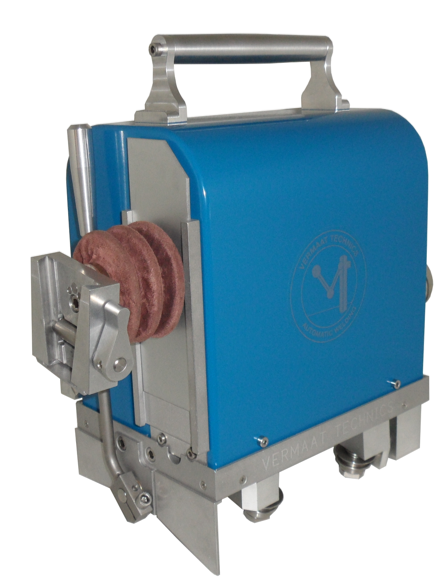
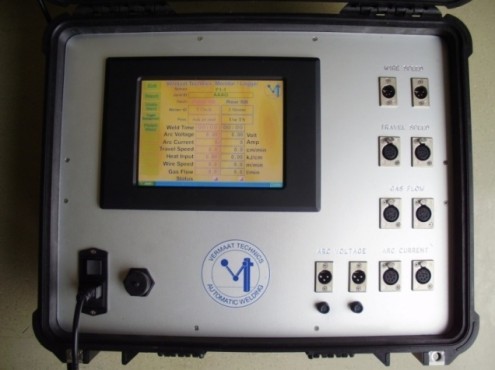
The VT logger is our portable weld process monitor and logging device, which allows monitoring the following welding parameters.
Travel speed:
Travel speed can be measured as follows:
Hall effect sensor fixed in a current box
Clamp-on meter for easy and fast connection
Wire speed:
Wire speed can be measured as follows:
Incremental encoder integrated in a wire straighter unit
Clamp-on DC tachometer
Gas Flow:
Gas flow can be measured as follows:
In-line Gas flow meter (max. pressure 25 Psi)
Every second a set of measurements is displayed on a small LCD monitor. When the arc voltage and arc current do so indicate, the measurement sets are stored on the logger’s harddisk. The measurements are grouped into layers, which have to be named by the operator; each layer is automatically divided into runs, each corresponding with the moment that the actual welding started. When a standard line printer is connected, then for every run a print-out is produced, with a line of data every second. While the VT logger is logging new data, older data can be reviewed as well.
General Specification (may vary for other models)
Dimension
468 x 355 x 193 mm18.4 x 14 x 7.6 inch
Weight
12.5 kg27.5 lbs(excluding probes etc.)
Protection
Watertight, crush proof & dust proof
Application
(P)GMAW, (P)GTAW, FAW, SAW
Techniques
Manual, Semi or Fully Automatic welding
Temperature range
-20 until +45 degrees Celsius-4 until +113 degrees Fahrenheit
Battery
Max. 4 hours of operation on full charge
Power
100 – 240VAC (50W)
communication
USB (memory stick)(Wireless) Ethernet (file sharing)Access possible over the Internet
THE VERAWELD
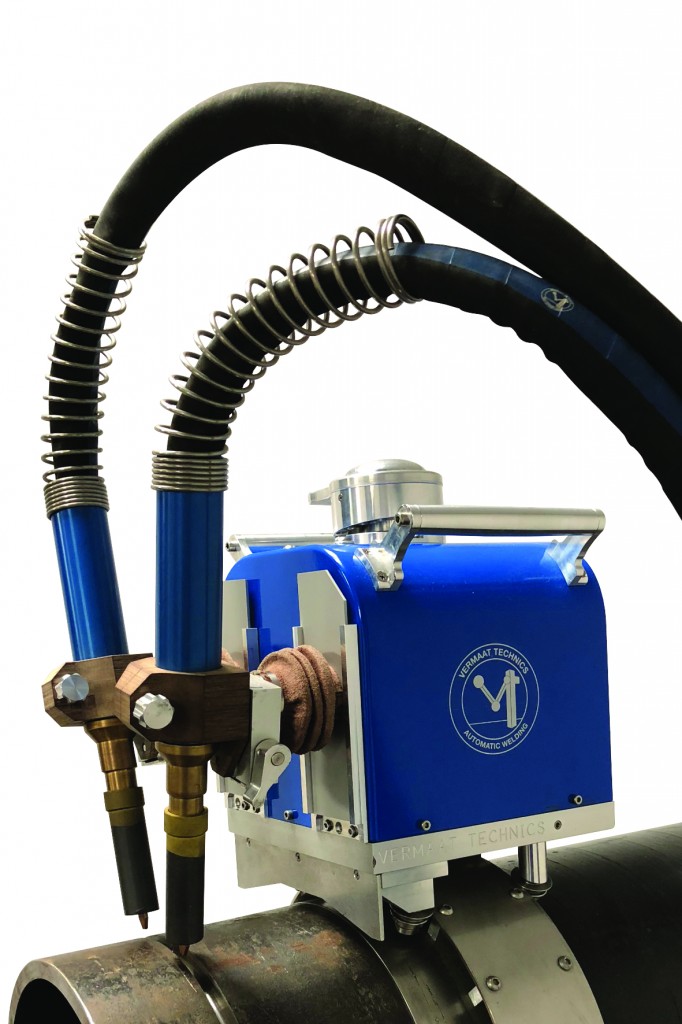
The Veraweld is our all-round robotic orbital welder, with which we have proven our expertise in developing and manufacturing computer aided welding equipment. The Veraweld system is a successful formula in the pipeline construction society, in both on- and offshore pipeline construction.
The basic elements for the success of Veraweld are:
the very high deposition rate, with a low repair rate
the flexibility in practical use
the light, small and solid design
the ease of operation
the ability to weld all passes and weld processes with one system
the ability of data logging off all welding parameters
the ability to hook-up Veraweld with client’s own auxiliary equipment
the all pipeline conditions resistant design
the Vermaat’s training and support facilities
the possibility for clients to own automatic equipment and know-how
Today’s computer and manipulation technology has created the possibility to preset all the welding parameters for each welding pass and for all positions over the entire pipe circumference into the computer. A complete set of preset values can be selected by just pressing a button on the remote control.
Single torch
The device is actually moving a welding torch along the seam. It allows the torch to move up and down, to move left and right and even to change the angle with the pipe surface.
Dual torch
The dual torch works the same as the single torch. The difference is that the dual torch has two welding torches which can be programmed differently from each other, therefore the dual torch is faster.
Bug remote controller 3 (BRC 3)
The Bug Remote Controller (BRC) is a little handheld button-box, which is connected to the BCC and allows the operator to select welding parameters for the current welding pass, to test the system, to start/stop welding and to make corrections during welding.
This Bug Remote Controller is third in line. Like is predecessors it allows the welder to control the bug in the most effective way.
VeraWeld ArcLink software gives the welding engineer the opportunity to make precise adjustments with the button parameters for welding within the tolerances of a welding procedure.
The Bug Remote Control is shock and dust proof, light weight and has flashlight support.
Bug control cabinet 5 (BCC 5)
The Bug Control Cabinet (BCC) contains all the electronics to control the Welding Bug, the wire feeder, the gas valve(s) and the welding converter. The new design makes it possible to use the BCC5 in very narrow spaces. By using the latest technologies Vermaat Technics realised a faster, more stable and user friendly Bug Control System. The BCC5 is functional with several different inverters and its software is naturally based on many years of experience.
Support software
The Support Software is a package of programs for a personal computer running Windows, which allows the operator to edit welding parameters for different welding passes, monitor the welding process during welding and print out welding reports.
Welding converter
A welding converter provides the power necessary to actually weld. Converters supported so far: Lincoln and Miller power sources
Wire feeder
Feeds the material in the welding puddle. Normally needs to be modified to work with our system. The welding-head (bug) then can be started to weld at any position in full accordance (and controlled by the computer) with the preset parameters. The computer controls the entire welding process, by monitoring and adjusting the following parameters:
welding current
arc voltage
welding speed
torch angle and height
pulsation speed (if used)
up and down slope
burn back
gas flow and pre flow
wire speed
operator interference through remote control
What we mean by multi-purpose and flexibility is the possibility to weld GMAW (MIG/MAG), FCAW (Inner shield and Outer shield), GTAW (TIG), or a combination of those processes and all the passes with the same equipment in a manner as explained before.
Data logging of the parameters of the actual welding execution will be appreciated by your proposed clients (pipelines consignees) because of the adaptability to their QA/QC programs and is an important contribution to a controlled and therefore better welding execution.
If you want to see our Veraweld system in action, do not hesitate to contact us to make an appointment for a live demonstration. You can use the question section on this site to do this.
Specifications for single torch
Travel speed
up to 4000 mm/min (157 inch/min)
Torch angle movement
40°
Oscillation speed
up to 5000 mm/min (197 inch/min)
Oscillation width
up to 42mm
Oscillation dwell
0.001 sec to infinite
Oscillation repeatability
up to 42mm
Oscillation width
0.05mm
Welding current values
40 – 400 Amp programmable in 1 Amp. Increments
Bug travel force
Three times it own weight including its umbilical
Pipe diameters
152 mm and up (6 inch)
Specifications for dual torch
Two torches
independently programmable, water cooled
Pipe diameters
152mm and up (6 inch)
Weight
11kg (26lbs)
Sizes
250 x 200 x 200 mm ( 9.8 x 7.9 x 7.9 inches)
Travel speed
up to 4000 mm/min (157 inch/min )
Oscillation speed
up to 5000 mm/min (197 inch/min)
Oscillation dwell
0.001 sec to infinite
Oscillation stroke
up to 43 mm (1.7 inch)
Height stroke
48 mm (1.9 inch)
Operating environment
-50 till +50 degrees Celsius
Privacy settings
To provide the best possible experience, we use technologies like cookies to store and/or access information about your device. By agreeing to these technologies, we may process data such as browsing behavior or unique identifiers on this site. Withholding or withdrawing consent may impact certain features and functionality.
Functional
Altijd actief
The technical storage or access is strictly necessary for the legitimate purpose of enabling the use of a specific service expressly requested by the subscriber or user, or for the sole purpose of carrying out the transmission of a communication over an electronic communications network.
Preferences
The technical storage or access is necessary for the legitimate purpose of storing preferences not requested by the subscriber or user.
Statistics
The technical storage or access used solely for statistical purposes.De technische opslag of toegang die uitsluitend wordt gebruikt voor anonieme statistische doeleinden. Zonder dagvaarding, vrijwillige naleving door je Internet Service Provider, of aanvullende gegevens van een derde partij, kan informatie die alleen voor dit doel wordt opgeslagen of opgehaald gewoonlijk niet worden gebruikt om je te identificeren.
Marketing
The technical storage or access is necessary to create user profiles for sending advertising, or to track the user on one site or across different sites for similar marketing purposes.

 The VT logger is our portable weld process monitor and logging device, which allows monitoring the following welding parameters.
Travel speed:
Travel speed can be measured as follows:
The VT logger is our portable weld process monitor and logging device, which allows monitoring the following welding parameters.
Travel speed:
Travel speed can be measured as follows: